
SPATCH USSD: A Carrier-Grade Unstructured Supplementary Service Data Gateway
Driving Instant Subscriber Engagement for Small to Medium Sized Mobile Network Operators. Deploy high-speed, session-based applications with a streamlined bridge between your core and your customers.
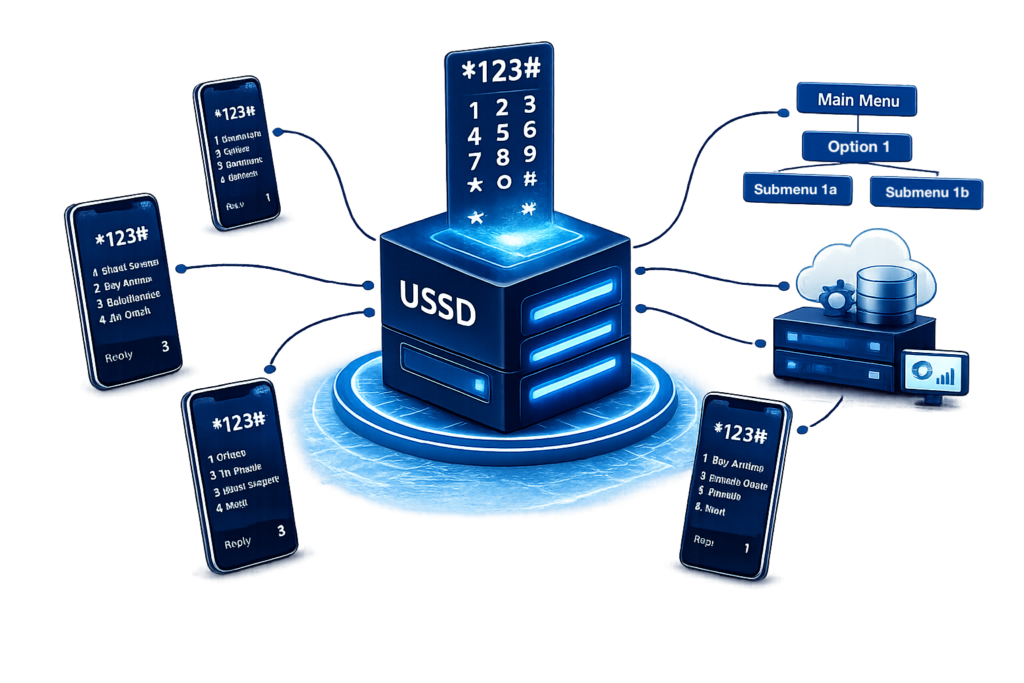
Lightweight Core, Heavyweight Performance
A high-performance, virtualized USSD Gateway engineered to handle the requirements of real-time subscriber services. Designed for seamless interoperability, the platform provides a stable foundation for essential services like prepaid balance inquiries, top-ups, and interactive service menus.
Unlike other high-maintenance systems, SPATCH USSD is a lightweight, agile core that integrates directly with your existing HLR/HSS and application servers. It bridges the gap between your legacy signaling and the evolving needs of your 5G transition.
Technical Specs & Integrations
Engineered for absolute interoperability within the modern EPC.
Signaling & Standards
Network Core
Operations & Deployment
Carrier-Grade Management
Access Control
Full Shell/Root Access and real-time UI. Includes built-in hooks for CALEA and regulatory reporting.
Cloud Agnostic
Virtualized deployment on standard VM or AWS
environments. OPEX-based pricing model.
Session Management
High-speed handling of mobile-initiated (PULL) and network-initiated (PUSH) strings with zero bottleneck.
Real-Time Analytics
Detailed session logs for monitoring traffic patterns and service success rates via unified dashboard.
Why Regional Mobile Network Operators are Switching to SPATCH USSD
The Hydeco difference: Performance, Access, and Predictability.
“Hydeco is extremely quick to respond, quicker than any vendor we've ever had. We pay for the services, but Hydeco is easily the best for delivering on what we're paying for.”
Director of Network Operations
Regional Carrier Network
Frequently Asked Questions
What is the difference between USSD and SMS for real-time subscriber services?
Unlike SMS, which is a "store-and-forward" protocol that can experience delivery delays, USSD (Unstructured Supplementary Service Data) is a session-based protocol. This means that when a subscriber dials a short code, a real-time, two-way connection is established between the handset and the USSD gateway. This session-oriented nature makes USSD the ideal "engine" for low-latency interactive services like prepaid balance checks, mobile banking, and real-time top-ups, where a delayed response would break the user experience.
How does a virtualized USSD gateway integrate with third-party A2P applications?
For small to medium sized mobile network operators, the USSD gateway acts as a critical bridge between the signaling core and the application layer. By providing standardized RESTful and HTTP/XML APIs, the SPATCH USSD Gateway allows your engineering team to route user-initiated strings to external application servers instantly. This enables the rapid deployment of menu-driven services—such as surveys, service activations, or financial transactions—without requiring complex "black box" configuration or professional services from a legacy vendor.
Can the USSD gateway solve Circuit Switched Fallback (CSFB) issues during the 5G transition?
Yes. A major challenge during the transition from 4G/LTE to 5G is maintaining seamless USSD functionality, as 5G cores handle supplementary services differently. A carrier-grade, virtualized USSD gateway ensures service continuity by supporting traditional Sigtran (M3UA) signaling for legacy environments while preparing the path for 5G service-based architectures. This eliminates the "pulling teeth" experience of troubleshooting dropped sessions or menu failures as your network infrastructure evolves, providing a stable "safe bridge" for your subscriber interactions.
See if SPATCH USSD fits your network
We offer complimentary 1:1 demonstrations of the product to show you how it works, explore all key functionalities and give you full visibility into the dashboard. Fill out the form below to schedule your demo today.